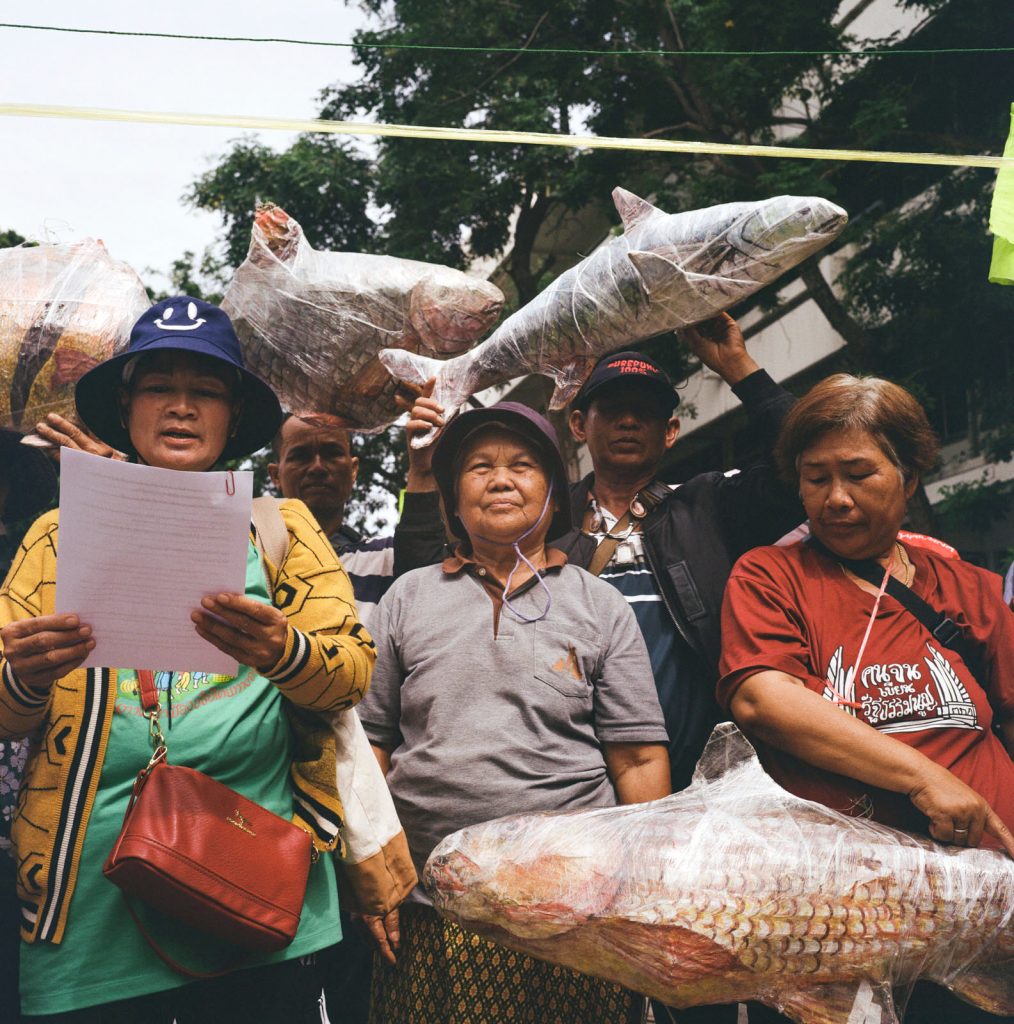
For the first time, an invasive fish that has devastated fisheries across 18 Thai provinces has been found deep inland, in a reservoir that researchers say could suffer the same fate.
Kalasin province, Thailand – The sun was just rising over Lam Pao Reservoir, its grey water flat and undisturbed, when Yutitham Pubuanak steered his small boat toward the shore, his morning’s catch piled at his feet.
As his boat reached the shore, he emptied the fish into a basket and carried it to a pickup truck, where a middleman was waiting to buy the day’s haul. Four other fishermen did the same.
“I have got plenty of fish,” Yutitham, 38, said smiling. “There are Nile tilapia, silver barb, clown featherback, mud carp, sheatfish, and redtail mystu.” He paused. “But no blackchin tilapia today.”
That could change soon. Weeks earlier, Yutitham had pulled a strange-looking fish from the same reservoir. It would turn out to be blackchin tilapia, an invasive species that has ravaged fisheries and ecosystems in 18 provinces along the Gulf of Thailand. It was the first confirmed sighting of the species in Thailand’s Northeast, and it has set off an urgent effort by officials, researchers and fishermen to determine how far it may have already spread.
The reservoir, a 380-square-kilometre expanse of man-made water, has long sustained the communities along its shore, who fish and farm its waters for a living. Now, researchers warn, those livelihoods could be jeopardised by the fish’s arrival.
An economic threat takes hold
In late August, Yutitham had found one strange tilapia during a routine fishing trip in Lam Pao Reservoir. It was small, with very firm scales and black spots underneath its mouth.
“I thought it was a weird looking fish, so I took a video and uploaded it on my social media channels,” he said. “That’s how people noticed that it was actually a blackchin tilapia.”
Later, Yutitham caught two other fish from a different spot in the reservoir. This time they were full-grown blackchin tilapia, their bellies full of eggs. Officers from the Kalasin Provincial Fisheries Office took the samples for identification and confirmed they were blackchin tilapia – the first official record of the species in the Northeast region.
He said many fishermen have caught the fish too, especially in the upper part of the reservoir. As of 25 September, over 100 blackchin tilapias have reportedly been found in the area.
Blackchin tilapia is a fish species native to West Africa. It is highly resilient, able to live in both saltwater and freshwater, and reproduces very rapidly, allowing it to easily outcompete other fish and dominate the ecosystem.
The species was imported from Ghana by Charoen Pokphand Foods (CPF) in 2010 for research purposes. Although the company insisted that it had destroyed all imported fish after the failed research attempt, the fish was found in the wild in Samut Songkhram in 2011 and quickly spread to other provinces along the Gulf of Thailand coast.
Due to its invasive nature, it has caused significant damage to aquatic ecosystems and fisheries in the affected areas.
Kasem Chetawan, a lecturer at the Faculty of Fisheries Technology, Kalasin University, said the finding of adult blackchin tilapia in Lam Pao Reservoir was very worrying, as it indicated that the fish had been introduced into the reservoir over a year ago and had already established a sustained population.
“We will never know for certain how blackchin tilapia spread to Kalasin, but we know for sure that they were brought here by humans,” Kasem said.
He suspected that the fish had either been accidentally mixed in with Nile tilapia juveniles bought by fish farms from the affected provinces, which then escaped into the reservoir, or that malicious actors had deliberately released them.
Either way, he stressed that blackchin tilapia pose a serious threat to the rich aquatic biodiversity and fisheries resources of Lam Pao Reservoir. The species preys on the juveniles of other fish and aquatic animals, he said, risking a population collapse among high-value species – and serious damage to the freshwater fisheries and aquaculture sector, which is one of the main economic engines of Kalasin.
Fish farms in Lam Pao Reservoir alone contribute up to one billion baht in income per year, Kasem said, citing a 2025 estimate from the Kalasin Fisheries Office. Kalasin’s giant river prawns, already registered as GI products, provide an additional one billion baht to the province, while traditional fisheries generate about 500 million baht for the local economy.
“All of these lucrative economic activities will be jeopardised unless we promptly deal with blackchin tilapia infestation.”
Containing the spread
Deputy Minister of Agriculture and Cooperatives Watcharapon Khaokham, who visited Kalasin on 26 September, said he had ordered relevant agencies to roll out proactive measures to monitor the spread of blackchin tilapia in Lam Pao Reservoir and connected waterways.
Several measures to prevent the fish from escaping into connected waterways would be implemented, Watcharapon said, including installing filtration or barrier systems in irrigation canals and targeting juvenile fish for removal within the reservoir.
Officials are prioritising juvenile fish specifically because they are approaching breeding age, Watcharapon said, and stopping them before they reproduce is central to containing the outbreak.
Meanwhile, fisherman Yutitham said he did not believe the provincial fisheries office’s plan to eliminate blackchin tilapia would be effective, and suggested the office set up a bounty instead.
“I’m sure that the local fishermen are far more efficient at catching fish than the officers, so I think they should buy blackchin tilapia at a high price, let’s say ten baht per fish, to be an extra incentive for fishermen to fish them all out of the reservoir,” he said.
Chainarong Setthachua, a lecturer at the Faculty of Humanities and Social Science, Maha Sarakham University, said authorities had done too little to handle the spread of blackchin tilapia.
“There has been no consistency in the governmental measures to deal with the issue,” he said. “The government should declare the affected provinces as disaster zones to muster all of its resources to stop the spread of this invasive fish.”
A disaster zone declaration would open the door to compensation for residents affected by blackchin tilapia, as well as faster access to the government budget for the province’s eradication efforts.
Deputy Minister Watcharapon himself acknowledged that past response measures had underperformed, admitting that inconsistent budgeting and insufficient personnel were partly to blame. He said the government is now scaling up its response, adding 29 partner agencies to the effort and seeking further funding and equipment.
Despite the concerns over the blackchin tilapia infestation, some local fishermen and fish sellers in Kalasin are taking a calmer view of the situation.
Salintip Untakhot, a local fishmonger, said she did not worry much about the presence of blackchin tilapia in Lam Pao Reservoir.
“I don’t think blackchin tilapia will spread very rapidly here, because Lam Pao Reservoir is freshwater rather than the brackish coastal waters they prefer. And if they do turn up, people here can easily turn them into pla ra (fermented fish).”
Ongoing lawsuits
The same month also brought two significant court rulings on the invasive species.
On 8 September, the Central Administrative Court ruled that the Department of Fisheries must oversee measures to suppress the blackchin tilapia outbreak in Samut Songkhram. It also ordered the department to declare the province, the first affected by the species, a disaster area, so that resources and budget could be distributed urgently to address the problem.
A second ruling followed on 14 September, when the Bangkok South Civil Court accepted a class-action lawsuit against CPF and eight other co-defendants, filed by a group of affected citizens in the provinces along the coast of the Upper Gulf of Thailand. The suit concerns the impact of the company’s business operations on the ecosystem and local livelihoods.
Panya Toakthong, a representative of the affected residents from Samut Songkhram, said the group was pleased by the court decisions, and urged people in other areas suffering from blackchin tilapia to pursue legal action against officials and the company behind the outbreak.
“The judgment of the Administrative Court only applies to Samut Songkhram, so I am supporting others who are also affected by this invasive fish to file lawsuits for prompt official action against blackchin tilapia,” Panya said.
He said the class-action lawsuit against CPF would involve lengthy litigation, beginning on 30 November. If the court rules in favour of the plaintiffs, the decision could set a precedent that other affected communities could draw on in filing their own claims against the company.
•
•
•
Get our latest stories direct to your inbox.