
As the World Bank returns to Bangkok, a river community asks it to remember
Photography by Luke Duggleby
Local fishing boats moored below the Pak Mun Dam while its gates were closed in February 2026. Photo: Luke Duggleby/HaRDstories
- Published
- 8 min read
For more than three decades, eight concrete gates have interrupted the free flow of the Mun River. This week, the World Bank that helped pay for the dam returns to Bangkok, and the fishers beside it say they are still waiting for what they were promised.
Every year, as the fish begin their run up the Mun River, Sompong Wiangchan waits to learn whether the eight concrete watergates of the Pak Mun Dam will open. Some years the order arrives weeks late. For more than three decades the dam has blocked the river’s last stretch before it joins the Mekong, and the fish, like Sompong, must wait for its gates to open.
The Mun, the colour of milk tea, moves slowly here. Most Pak Mun villagers are small-scale fisherfolk whose time is measured by sunrises and seasons rather than hours and minutes. Only Sompong and a handful of neighbours still keep watch on the gates.
“Nowadays, some of my community members think they [the authorities] will surely open the gates when the rain comes so the fish can lay eggs. They have forgotten that we fought hard to get this order,” said Sompong, a 77-year-old community leader “And this is actually just a temporary mitigation to stall a promise that has never been met!”
Pak Mun, a 136-megawatt run-of-river dam, was part-financed by the World Bank. It promised water and energy security for the region. Instead, villagers say, it devastated the river’s fish, and with them their livelihoods; many are still waiting for compensation.
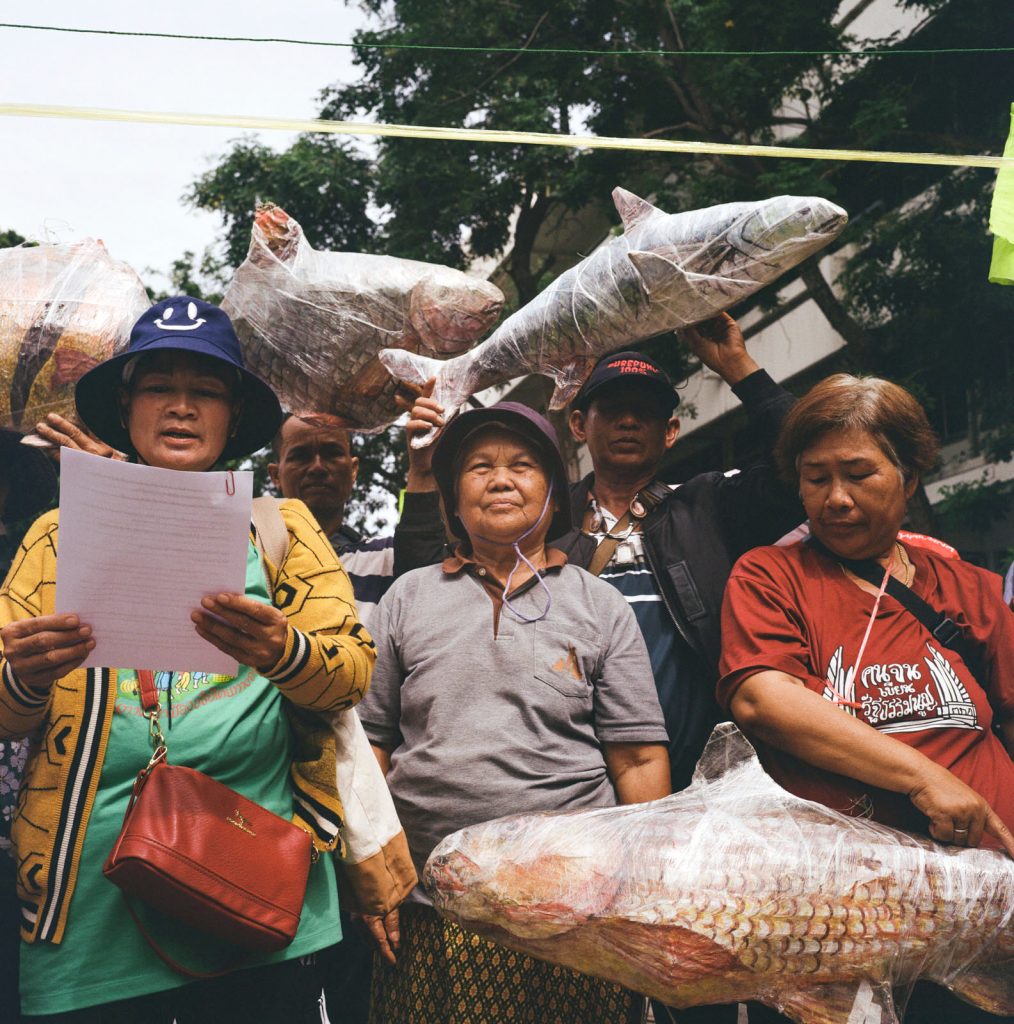
The Bank approved the loan for Pak Mun in 1991, the year it also held its annual meeting in Bangkok. This week it is back in the city, where bankers and leaders will discuss a new development agenda to help countries lift their economies. Outside the conference halls, Sompong and her neighbours want something simpler: a river that runs free. An exhibition on their struggle opens on 13 October at the Bangkok Arts and Culture Centre, while activists take to the streets to demand that the Bank not repeat what happened on the Mun.

1991: the day the Bank came
One of the photographs that will hang in the exhibition was taken in October 1991. In the centre, a Western man in a white shirt speaks to more than 600 Pak Mun villagers at Kaeng Saphue, the rocky rapids on the Mun that locals feared would disappear if the dam was built.
Campaigners from the time identify him as E. Patrick Coady, then the Bank’s US executive director. The villagers had invited the Bank’s delegates for the United States, Australia and Germany to “The People’s Forum”, a counter-meeting held alongside the Bank’s annual meeting, amid heated debate over whether the dam should be funded. The delegation was welcomed with a traditional Bai Sri Su Kwan blessing ceremony.
Two months after the visit, Coady and the two other World Bank country representatives voted against funding Pak Mun. Coady said that the Bank had failed to resolve uncertainties regarding the impact of the dam on fish species and the precise number of people to be resettled.
The Bank’s board usually decides by consensus, so a split vote was unusual. Witoon Permpongsacharoen, who then worked with the Project for Ecological Recovery, the group that arranged the villagers’ meeting with the Bank’s representatives, called it “a rare occasion for the Bank to have a non-consensual funding vote”.
The project also cost far more than planned. Its cost rose from about 4,5 billion baht (177 million USD) at the Bank’s appraisal to about 6,56 billion baht (about 233 million USD at the time), an increase of 45 percent in baht, according to a Thailand Development Research Institute report commissioned by the Bank. The dam has also generated only about a tenth of the electricity predicted.
Pak Mun has since become a cautionary tale in the history of hydropower. After resistance to big dams around the world, an independent body, the World Commission on Dams, reviewed more than 77 projects and found that their social and environmental impacts were routinely underestimated. Its report came out in November 2000.

Lenders then stepped back from hydropower and tightened their social and environmental safeguards. But a few years later, the World Bank returned to large dams, backing Nam Theun 2 in Laos as a model of “sustainable hydropower”. The project still displaced more than 6,000 villagers, many of whom were unable to make a decent living.
“It has become a pattern. The World Bank is the architect behind infrastructure projects. They overlay an economic model blueprint for developing countries: more industrial expansion, more electricity supply needed, more hydropower,” Witoon argued. “And then window dressing – portraying falsely attractive pictures of performance to draw investment from the private sector in these infrastructure projects.”


A river divided
Despite efforts to limit the damage during the design process, Pak Mun displaced about 400 households and affected fishing livelihoods in 66 nearby villages, according to the World Commission on Dams.
For local fishers, the worst blow was to the fish migration, which took away a living that no sum of money can replace. The Mun is rich in life, with more than 230 species of fish, over half of which swim up from the Mekong to spawn. But the fish could not cross the ladder installed as mitigation, local fishers and environmental experts say. The Electricity Generating Authority of Thailand (EGAT), the state utility that runs the dam, told HaRDstories the ladder worked as designed between 1994 and 2000, until fishers began trapping fish at its entrance.
By splitting the river, the dam has split its communities. Friends and cousins no longer speak, villagers say, because managing the dam either way hurts one side. Upstream, fishers can fish only when the gates are lifted. Downstream, where the rapids were blasted with dynamite to deepen the channel for the turbines, the reality is different. In Ban Hua Heo, a community of 1,300 residents, fishers catch enough only when the gates stay shut: Mekong fish gather in front of the dam, but once the gates lift they move upstream and find other habitats.
“Ban Hua Heo was sacrificed for Pak Mun Dam construction,” said Boonlai Wiangchan, a headman in the village. “Before it was built, I used to protest against it too. But today we have to find ways to live with it. We don’t want the watergates to lift up.”
The long wait
Villagers affected by the dam have received some compensation, in amounts that vary with their circumstances, for relocated homes and lost income. But that covered only the three years of income lost while the dam was built. No fisher has received the central promise, made in 1997: 15 rai (2.4 hectares) of land each, to help them move into farming and survive in the long run.
“When Thai people hear the news about Pak Mun, they think, ‘Why does their struggle never end? They already received compensation, right?’” said Namphueng Hatsatheethum, 52, an archivist who is documenting Pak Mun’s history. “I used to think the same. But looking back at the entire history, I came to understand that they haven’t received what they deserve, and this should not be misinterpreted.”
That unkept promise is why the gates are lifted every year. The authorities could not find enough land, and in 2004 they agreed with the pressing communities to open the gates for four months annually as an ad hoc solution.

Pak Mun is regarded as one of Thailand’s strongest grassroots struggles of the 20th century. Its solidarity inspired the Assembly of the Poor, the national network that represents people affected by state development projects, from dam-hit villagers and landless farmers to slum dwellers, and negotiates collectively for compensation or the cancellation of top-down programmes.
Namphueng was a student activist drawn in by the movement. Then a biochemistry student, she gave up that career path to join the struggle, and her first job was at Friends of the People, a local NGO that worked alongside the movement and documented it with a single film camera.
Thirty years later, the disbanded NGO’s former members have come back together to preserve that memory, saving more than 50,000 film negatives that heat and humidity were slowly destroying after years in kitchen cabinets. Some of the photographs are now being shown in an exhibition at the Bangkok Arts and Culture Centre.
The memory of Pak Mun is not only tragic but inspiring, including for Thanathorn Juangroongruangkit, the auto-parts billionaire and co-founder of the reformist Future Forward Party, a forerunner of today’s People’s Party. Thanathorn spent his student years visiting Pak Mun. “Getting involved with the Pak Mun protests and the Assembly of the Poor movement back then really shaped my class and political consciousness,” he said.
Who answers for Pak Mun?
The World Bank lent part of the money for Pak Mun, but says that whether to build a dam, and how to compensate the people it affects, is for each government to decide. It describes its own role as advisory, offering voluntary suggestions to its member states.
“Pak Mun is part of a broader set of lessons that have shaped how we approach environmental and social risk,” a World Bank Group spokesperson said in an email to HaRDstories. “Over the past three decades, we have significantly strengthened our standards, including mandatory stakeholder engagement, grievance mechanisms, and biodiversity protections.”
The Bank did not respond when asked whether it had followed up on Pak Mun, or on other hydropower projects it financed in the 1990s whose affected communities have not been compensated.
EGAT did not tell HaRDstories how much electricity Pak Mun generates today, or whether the dam is worth the investment. In a statement, it said its current management strives to balance the country’s energy interests with the long-term preservation of natural resources. According to its cost-benefit analysis, the dam is expected to operate until at least 2042. Whether it will keep running after that is not yet known.


“The Pak Mun communities have sacrificed so much, a sacrifice they never wanted to make,” said Namphueng. “Without this set of histories, our society will not be able to see the values of natural resources and community livelihood. Once lost, it is hard to gain back.”
As the Bank returns to Bangkok, Pak Mun’s villagers are joining Thai activists, in the exhibition hall and on the streets. The People’s Network Against the World Bank and IMF, which Sompong belongs to, says its fight is wider than any one dam. “We live with and resist the consequences of a development model that gives capital, markets, and economic growth power over our lives,” it said in a statement last week.
Back on the Mun, Sompong will go on watching the gates. She hopes the dam will one day keep them open all year, so the river can run free. But she says Ban Hua Heo, the community hit hardest, “should be compensated most among us”.
Whatever comes next, and whoever pays for it, she says, should first have to answer three questions. “When there are investment projects, by the state or whoever, we need to ask first: What do they invest for? What are the conditions coming with it? Do the people receive or lose benefits from it?”
Nicha Wachpanich is a Bangkok-based journalist covering stories from a rights-based and human-interest perspective. She previously worked with a local environmental news agency under Thai Society of Environmental Journalists.
Luke Duggleby is a long-time Thailand based photographer. He regularly works on stories related to human rights, the environment and the impact of pollution and development on local communities.
More Features


- by Veerapong Soontornchattrawat


