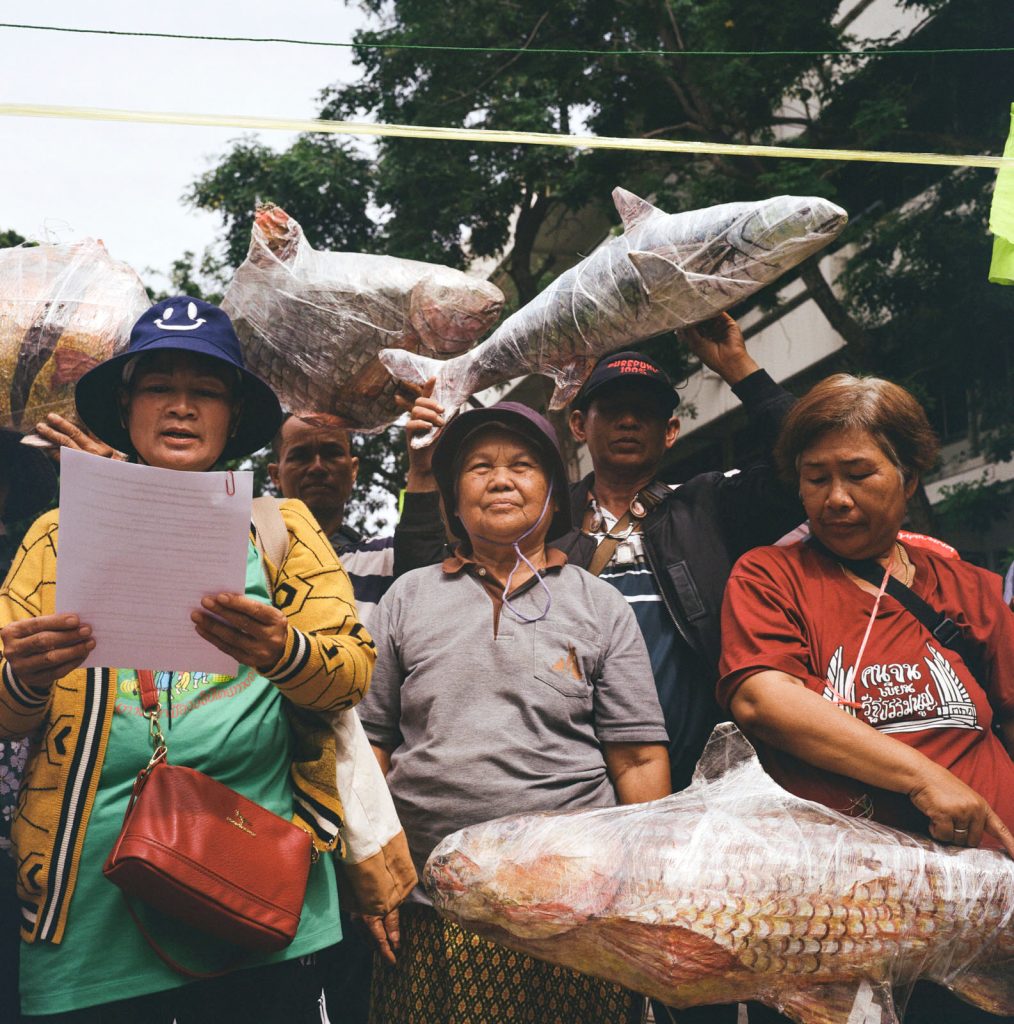
The Pak Mun Dam has become a symbol of top-down development gone wrong. For more than three decades, Sompong Wangchian has refused to let Thailand forget what it cost.
Pak Mun communities led by veteran anti-dam campaigner Sompong Wiangchan (centre) read out a statement outside the Office of the Public Sector Development Commission in Bangkok on 17 September 2026. Photo: Luke Duggleby/HaRDstories
In a pitch-black theatre in Bangkok’s Thong Lo neighbourhood, a fisherwoman stood under the stage light, dressed in a traditional pa-tung skirt and an advocacy-campaign T-shirt. Sompong Wiangchan raised her voice, clear and confident, over the crowd.
“After the hydropower dam was constructed, our livelihood has never been the same.”
Sompong, then 75, was no actor. She had simply said yes when a young artist invited her to share her story in a lecture performance in September 2024. She needed no script. She knew the words by heart.
She had spoken for the Pak Mun communities countless times before: on the streets, to fellow protesters, to several prime ministers, as part of one of Thailand’s largest grassroots movements. Now the crowds that once filled Bangkok’s streets are gone, and the struggle rarely earns more than a few lines in the news. So Sompong has found a new stage, a new audience and the same mission: to spread the word as far as she can.
For someone who has spent more than three decades in a tug of war with the dam, this is how she keeps hope alive.
River at her doorstep
Sompong grew up beside the Mun, the longest river in northeastern Thailand and a lifeline for millions. It joins the Mekong at Pak Mun, “the mouth of the Mun”, in Ubon Ratchathani province, on the Thai-Lao border.
She was eight when she first followed her father out to lay fish traps, a skill she counts as the best gift he gave her. He died young, and she helped raise her younger siblings.
In the early 1960s, she remembers, traders came by wagon along the rocky road to swap rice for the villagers’ fish. “When I became a teenager, my father traded fish to get me a very nice blouse.”
Sompong was in her forties when word spread among the fishers that the river was to be dammed. A 136-megawatt hydropower dam would rise at Pak Mun, just five kilometres before it merges with the Mekong.
The National Energy Policy Office, which backed the project, said the eight-gate dam would store water for farming and generate electricity. It would be a waste, the agency argued, “to let this much water flow into the Mekong for nothing.”
For the fishers, the problem was the fish. Every year, between January and August, more than a hundred species swim up from the Mekong into the Mun to breed. A concrete wall across the river would block their way.
When the cabinet approved the dam in 1989, the villagers who would live in its shadow pushed back. Thousands protested and demanded fair compensation for the livelihoods it threatened.
Fishing families, grandparents and small children among them, later occupied the construction site and carried their protest to Bangkok. Urban activists and villagers from other communities hit by big state projects joined them. Out of this struggle grew the Assembly of the Poor, one of the country’s most powerful grassroots movements.
Today, Sompong is Mae Sompong, “Mother Sompong”, one of the movement’s most persistent leaders. She keeps speaking for Pak Mun even though many of her neighbours have lost hope.
“I was not a leader in the beginning. There was Mae Sribun Ornsri, Po Prasert Thongkum… I was just a messenger, cycling from one village to the next when we had community meetings,” she said. “Many of the first generation of defenders are gone now. There was no one left to represent our community in the negotiations, so I had to step up.”
“Victory through non-violent means”
The movement gave its leaders kitchen names. Sompong was a Mae Krua Yai, a “head cook”, and she carried her neighbours’ demands into negotiations with the state. The struggle peaked in the 1990s, when more than 10,000 protesters filled the streets of Bangkok.
“It was a code name, to avoid attention from government agents at protests,” Sompong explained, as if it were perfectly ordinary.
Flipping through archive photographs during an interview with HaRDstories, Sompong smiled at her younger self, fist raised among her comrades at the dam site in 1994. Their hand-lettered banner read: “Victory through non-violent means.”
Beside the villagers stood activists from Bangkok, among them Wanida Tantiwittayapitak, a prominent organiser who became a central figure in the Pak Mun campaign. Young and committed to social justice, Wanida brought wide connections and inspired the fishing communities to unite.
•
•
Compensation came only after a long series of peaceful protests. In one, Sompong and Wanida climbed down a makeshift bamboo ladder to the Mun with a hundred women and occupied the riverbed, where crews were blasting rock for the dam. Each woman had brought two pa-tung skirts to sleep on.
Wanida asked whether it was too risky: if the blasting continued, they could all die. “If we have to sacrifice our lives, then let it be,” Sompong answered. “We have to fight! In the worst case, our children will continue the struggle and win compensation.”
The sit-in lasted ten days. Men joined soon after, and the crowd grew past 300. The dam’s builders ignored them, put up extra protective netting and kept blasting the rocky rapids to deepen the channel. Then the peaceful protest was met with rocks and batons from pro-dam village headmen and police officers, leaving several casualties.
In the end, the Electricity Generating Authority of Thailand (EGAT) sent negotiators, and the two sides agreed on fairer compensation. Stopping the dam was already impossible. The villagers pressed instead for transparency about the area to be flooded, and for compensation for their homes, farms, fishing and health, harms they said the project’s own surveys had played down.
It was a victory, but a short one. The agreement promised much and delivered little, and Sompong would spend the decades after reminding the state of what it owed.
Life after the dam
When the Pak Mun Dam began operating, it had cost far more than planned: 6.56 billion baht (about 233 million USD at the time), up from an estimated 4.5 billion. That was close to a third of the national public health budget in 1991. A review commissioned by the World Bank, which co-funded the project, found that “because of cost overruns from compensation, the project’s benefits became marginal.”
The fish ladder, built so that Mekong fish could still swim upstream, did not work, experts said. Nor did the plan to turn fishers into farmers. Families received some compensation for their relocated homes and for three years of lost fishing during construction. But the compensation that mattered most never came: 15 rai (2.4 hectares) of land for each, to help them move into farming for the long term. The state said it could not find the land.
Each new government brought new officials, and old promises were quietly dropped. So the people of Pak Mun kept returning to the fight, from the dam site to the streets of Bangkok, with a new protest for every broken deal.
“We have been fighting with many tactics. Our struggle has gone through 16 governments and 19 prime ministers,” said Sompong. After the dam began operating, she gave up the fishing boat and drove a tuk-tuk in a town 35 kilometres from home, as a second income.
With the dam in place, the Mun no longer provides enough. Only from June to September, when the gates are raised, does the quiet river come alive. Fishers seize the moment, setting traps as the fish swim up and selling their catch to local restaurants as a speciality.
After so many years, the struggle has worn the community down. Many no longer believe the compensation they were promised will ever arrive.
But Sompong believes the struggle is still worth it. The gates open for four months every year because villagers fought for it, and because they keep returning to make sure it happens.
In August, while the gates stood open, Sompong organised a half-day gathering named Fish-Eating Day. More than a hundred villagers and allies from across the country shared a meal and talked about what dams do to a community. Sompong moved between the two groups, welcoming the elders, some in their nineties, then turning to introduce them to guests who had travelled more than a thousand kilometres.
Among them was Sohabuddeen Lohyapha, a 31-year-old Malay-Thai man from Yala, in Thailand’s Deep South. At home, he is leading the fight against the planned Krong Pinang dam, which many fear will alter the river’s ecosystem. An elder in his hometown, a veteran of the Assembly of the Poor, first told him about Sompong.
“I thought only Mae Sompong was left fighting Pak Mun. But coming here, I see that others have their roles in the fight,” Sohabuddeen said. “Mae Sompong is well known because she is great at reaching out to networks. But many others prefer to fight at home. This is something I wish to apply in my community.”
Hope remains
Sompong, now in her seventies, lives with her great-grandchildren. But she is far from retiring. Her days go to phone calls from community members, monthly meetings, and trips across the country to tell other communities what happened at Pak Mun.
She knows the damage cannot be undone. The dam will not come down any time soon, and the land promised to the villagers exists only on paper. But she is determined that it should not happen anywhere else.
Her eldest daughter follows in her footsteps, with a passion for fishing. She still takes the boat out, though the Mun is not as rich as in her mother’s days, and cooks for her family. “Eat up before you start your day” is the household motto, and the family shares its meals. When the visitors arrived, Sompong and her great-grandchildren gathered around the table and made room for them.
“I wish other people would see what has been left at Pak Mun,” Sompong said. “Here is the dam. Do you see how it failed? Thirty-six years have gone by. This is how the state uprooted our community. This is our pain.”
“Don’t build more dams.”
This story production was supported by Asia Pacific Forum on Women, Law and Development (APWLD)’s Feminist Media Fund for Alumni.
The photography production was supported by the International Institute of Social History in the Netherlands
Nicha Wachpanich is a Bangkok-based journalist covering stories from a rights-based and human-interest perspective. She previously worked with a local environmental news agency under Thai Society of Environmental Journalists.
Luke Duggleby is a long-time Thailand based photographer. He regularly works on stories related to human rights, the environment and the impact of pollution and development on local communities.
Get our latest stories direct to your inbox.